POST /action
→ 200 OK“Task complete.”A transport response can prove that a request was accepted. By itself, it does not prove the intended external state now exists.
SALT19 builds governed, verifiable AI systems that bridge the gap between model intelligence and real-world execution. The goal is not merely to issue actions, but to preserve authority, observe outcomes, verify state change, and attach evidence to what the system believes happened.
Most software agents can issue an action and receive a successful API response. SALT19's systems work toward the harder boundary: separate intent, execution, observation, verification, and belief admission so an autonomous system has evidence for what actually changed.
POST /action
→ 200 OK“Task complete.”A transport response can prove that a request was accepted. By itself, it does not prove the intended external state now exists.
Three recurring design pressures connect SALT19's work: operational authority, sovereign/local computation, and evidence strong enough to challenge an agent's own claims.

AeroClear and TacWing-X are built around operational context, explicit authority boundaries, and human-supervised use rather than treating an AI output as flight authorization.
See the TacWing-X authority model →
DroneMesh and local-first SALT19 tools keep important processing paths close to the operator, reducing dependence on centralized services when privacy, resilience, or field conditions matter.
Explore DroneMesh →.jpg)
EvoMind's governed cognitive work emphasizes verification, memory, planning, and inspectable execution so progress can depend on evidence rather than fluent self-report.
Open validation evidence →These demonstrations run in the browser. The DroneMesh viewer loads static site assets only after you ask for it. The Agent Utility Grid walkthrough is intentionally offline and creates no Worker or D1 traffic.
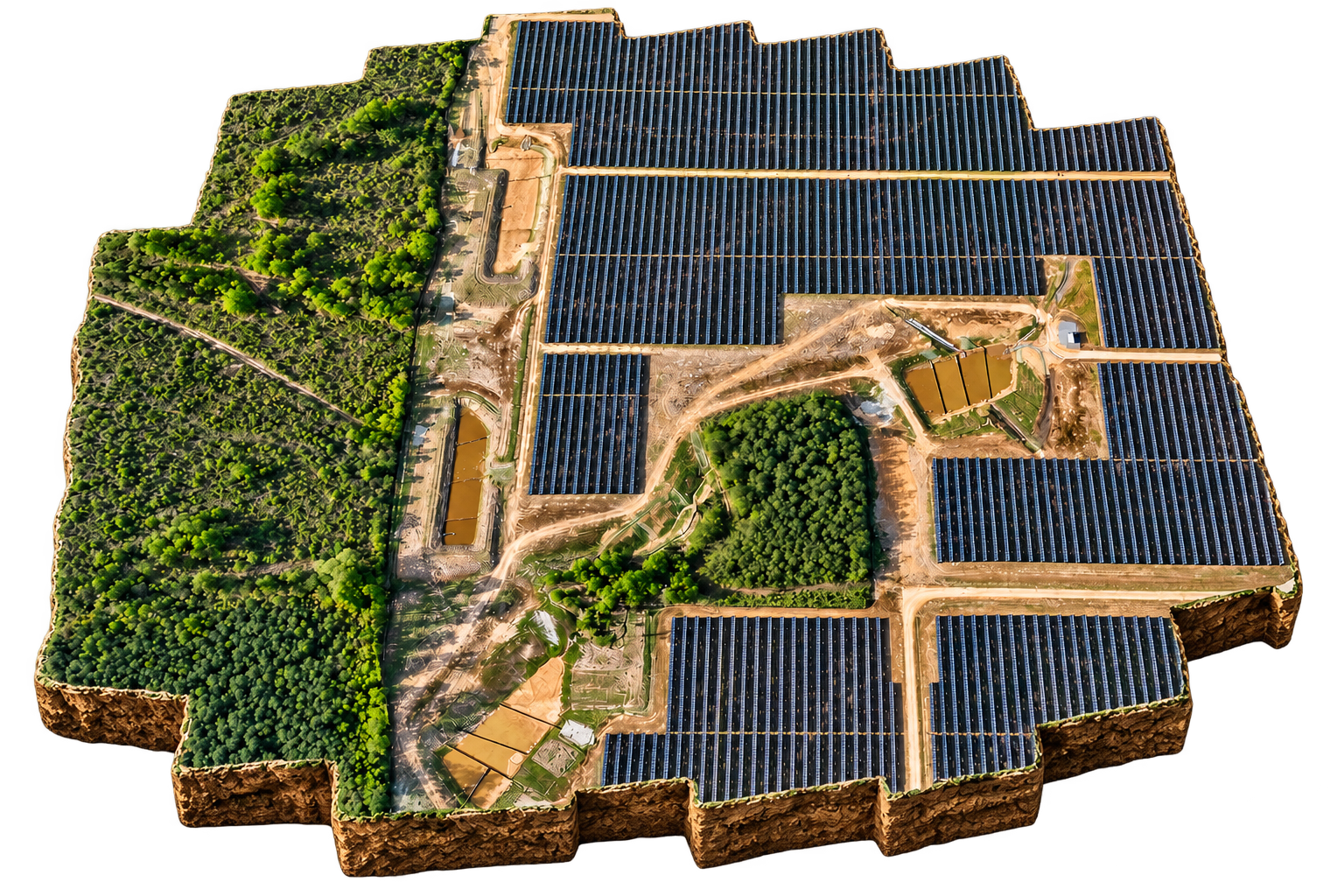
Launch the existing DroneMesh browser viewer and interact with a locally processed orthomosaic presentation. The carved-earth effect is presentation geometry, not measured elevation.
$ discover utility
{
"tool": "example-go-no-go",
"transport": "MCP / HTTP",
"commerce": "x402"
}
# Local demonstration only. Nothing was sent.This is intentionally not a live dashboard. It is a deterministic client-side walkthrough of the request → payment requirement → settlement authorization → structured result → receipt shape. It does not contact api.salt19.com, broadcast a payment, query D1, or add load to the production Agent Utility Grid.
Technical credibility is easier to understand when the evidence trail is attached to a concrete engineering problem instead of presented as a wall of specifications.
Action completion and state verification are different claims.
Separate planning, governed execution, observation, verification, and durable evidence.
Validation reports and DOI-backed EvoMind research expose the architecture and its tested boundaries.
Photogrammetry pipelines can be costly, opaque, and operationally dependent on remote services.
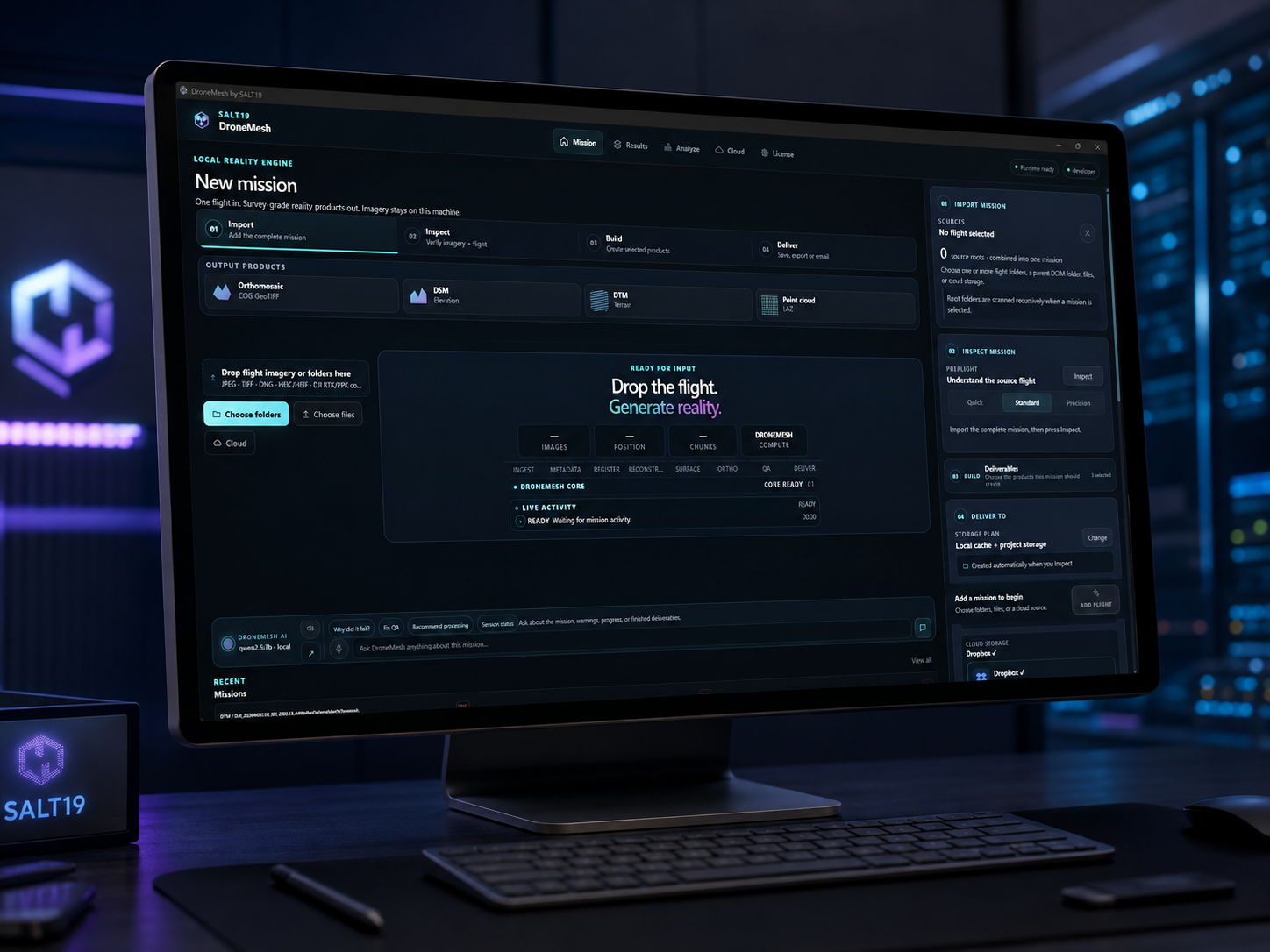
DroneMesh is being engineered as a local-first desktop production pipeline with explicit evidence and output surfaces.
The site exposes real processing outputs, visual comparisons, and an interactive orthomosaic presentation.
Perception demos can look perfect when failure frames disappear from the story.
TacWing-X keeps operator authority explicit while local perception, tracking, OCR, telemetry, and federation mature.
The lab record shows real model errors alongside working capability rather than presenting beta output as production certification.
Yes, the beta briefly called a roughly 200 lb Presa Canario a cow and a table a chair. Those frames remain part of the public TacWing-X story because an honest failure boundary is more useful than a perfect montage.
See the unpolished evidence →SALT19 is building the governed software layer between increasingly capable AI and real-world work: machine-native services, UAS flight intelligence, local geospatial production, supervised autonomy, AI-assisted engineering, and persistent cognitive systems.
SALT19 in one sentence: one reusable engineering spine for governed AI, machine commerce, UAS operations, geospatial production, and autonomous systems — with multiple routes to market and public proof surfaces.
SALT19 is a private company. This page is informational and is not an offer to sell securities.
Model capability is accelerating while real deployment still needs governance, verification, provenance, local execution, and domain-specific integration.
Cognition, verification, machine services, UAS intelligence, geospatial processing, and operator-control patterns are engineered as reusable system capabilities rather than isolated demos.
Commercial paths include software subscriptions, local desktop licensing, enterprise and government deployment, developer infrastructure, and machine-to-machine paid utilities.
Live products, production machine endpoints, public engineering updates, DOI-backed research, and validation records give investors a diligence trail beyond presentation slides.
AI Dispatch turns Gabriel Allit's AI and AGI writing into a first-party technology publication. ARCS and SALT19 research surfaces preserve DOI-backed records, research discovery, validation boundaries and engineering updates.
Congress is considering moratoriums, testing requirements and tighter controls on advanced artificial intelligence. At the same time, the U.S. government is putting frontier models into the hands of millions of personnel and preparing agentic AI for increasingly sensitive…
Modern agent systems can call models, route among heterogeneous backends, retain memory, invoke tools, and act on external environments. The harder systems problem is proving where neural inference is actually wired, whether it is reachable on the…
Explore the ARCS research community, Research Digest and Radar, then follow SALT19 development updates across UAS, agent infrastructure, governed cognition, geospatial production and local AI systems.
AeroClear is live with a broader aviation-data picture through FAA SWIM integration. At the same time, SALT19 is advancing three new systems for drone-data production, UAS operations, and local AI software engineering.

DroneMesh turns aerial imagery into immersive mapping products from a local-first desktop workflow. Explore the first orthomosaic, interact with the carved-earth presentation, and see where SALT19 is taking drone-data delivery.
DroneMesh · First OrthomosaicCaptured by drone · locally processed · digital twin ready
From UAS flight intelligence and machine-native services to drone-data production, autonomous operations and local AI engineering.
Operational software, production infrastructure, and public research surfaces.
UAS flight intelligence for weather, GNSS/Kp, terrain, nearby cooperative traffic, launch windows, FAA SWIM aviation data and flight reports.
Explore AeroClear →Machine-native technical services exposed through MCP with x402 payment gating, structured outputs and verification evidence.
Explore Agent Utility Grid →Persistent reasoning, memory, planning, governed execution, verification and controlled experience-driven improvement.
Explore EvoMind →Public previews describe what exists now and clearly separate current capability from future scope.
REAL DRONEMESH INTERFACE
A private, local-first photogrammetry workstation that turns drone imagery into orthomosaics, elevation products, point clouds, 3D geometry and field-ready export packages.
Completed full-mission production run on a local workstation. Runtime is specific to this mission, profile and hardware.
Preview DroneMesh →An Android operator display and edge-autonomy foundation for live telemetry, resilient localization, mapping, platform state and human-supervised robotic operations.
Preview TacWing-X →A Windows-first, local-first AI coding workspace with local models, repository intelligence, editor/LSP tooling, Git review and governed agent workflows.
Preview CloneCode →EvoMind is engineered as a persistent cognitive system rather than a prompt wrapper: reasoning and planning operate over durable state; semantic work requirements resolve into existing capabilities; execution passes through governed authority; and successful experience is reused only through controlled, reversible mechanisms.
Bounded validation exercises objective decomposition into distinct work-product requirements.
Distinguishes attempted operations from identifiable resulting artifacts with provenance.
Consequential execution requires explicit admission and control boundaries, keeping planning, authority, action, and verification distinct.
Compatible agents can discover SALT19 technical services through the official MCP Registry and machine-readable endpoints, receive a real x402 payment challenge, settle in Base USDC, execute the canonical paid tool, and receive structured results with verification and reconciliation evidence.
io.github.GabrielAllit1/
salt19-agent-utility-grid
Version 0.5.1 points compatible clients to https://api.salt19.com/mcp.
Technical preflight, reliability, and bounded decision utilities are live behind the canonical x402 payment authority.
Demand-gated remaining demand-gated candidates exist in source with schemas, bounded prices, and claim boundaries before promotion.
Five Phase 1 products are active, including code-change risk gating, plan verification, claim/output verification, repository adoption, and dependency-upgrade decisions.
Commercial activity is admitted to the revenue record only after payment settlement and successful execution are verified against the same transaction.
Organized around persistent state, reasoning and planning, semantic capability resolution, governed admission, real execution, and outcome verification.
Carry session, memory, project, and workflow context across more than one turn or process boundary.
Interpret desired outcomes, evaluate constraints, and construct multi-step capability plans before acting.
Express work semantically and bind requirements to available implementations rather than hard-coding paths.
Separate cognitive intent from execution authority with explicit policy, scope, approval, and revocation boundaries.
Operate browsers, documents, files, and local applications through controlled execution layers.
Check resulting state rather than treating a returned tool call or attempted action as proof of success.
Preserve identity, versions, source references, provenance, and relationships among resulting work products.
Promote bounded evidence from success, recovery, and correction only through governed, reversible controls.
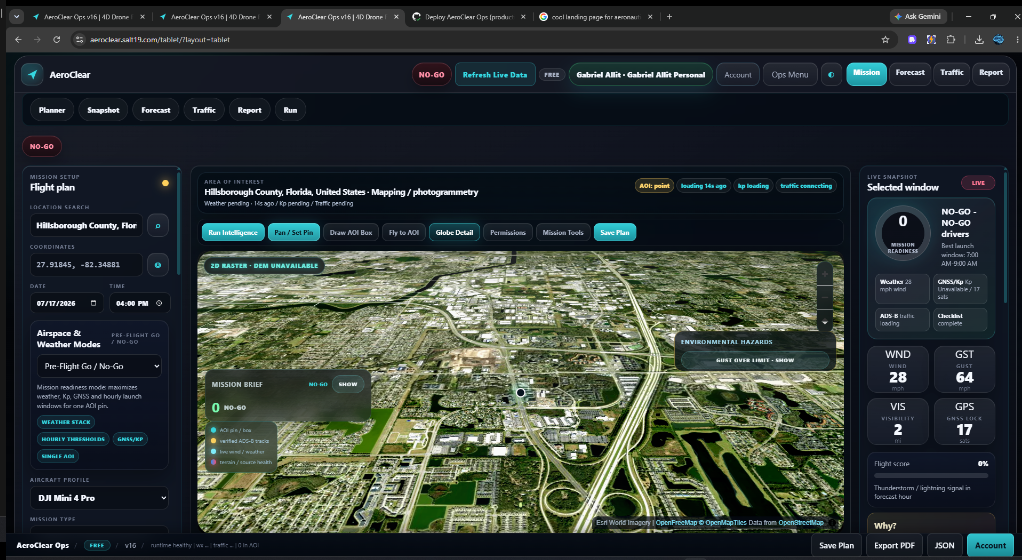
Plan an area of interest, compare hourly launch windows, evaluate aircraft limits, review weather and space-weather context, inspect nearby cooperative crewed-aircraft activity, incorporate aviation information delivered through FAA SWIM data services, and export a structured flight report from one responsive platform.
AeroClear is designed to support pilot-in-command decision-making alongside regulatory authorization and required preflight procedures.
SALT19 favors device-native and privacy-aware operation where practical so files, workflow context, and memory can remain close to the user.
How SALT19 Works →Reason before action, authority before execution, verification before belief, evidence before capability claims, and explicit policy around consequential autonomous behavior—including machine-to-machine commercial decisions.
Open Validation Record →SALT19 separates research hypotheses, published mechanisms, runtime demonstrations, benchmark evidence, commercial telemetry, and current engineering validation instead of collapsing them into one marketing claim.
Recent bounded validation exercises a high-level objective becoming multiple required work products through semantic capability resolution.
Execution evidence distinguishes attempted operations from identifiable resulting artifacts with version and provenance information.
Production machine infrastructure adds externally discoverable MCP distribution, canonical x402 payment gating, and bounded commercial telemetry to the SALT19 systems portfolio.
Continuing to ship operational software alongside the research program, providing UAS flight intelligence and mission planning.
An independent applied AI and autonomous-systems lab building UAS flight intelligence, drone-data production, autonomous operational software, local AI engineering tools, machine-native services, and governed cognitive systems.
SALT19’s flagship governed cognitive architecture for persistent reasoning, memory, planning, capability composition, and verified execution.
Production machine-to-machine infrastructure for AI agents to discover and invoke technical utilities through native MCP and machine-readable surfaces, with canonical x402 payment gating and bounded decision receipts.
Yes. Version 0.5.1 is published as io.github.GabrielAllit1/salt19-agent-utility-grid with remote MCP endpoint https://api.salt19.com/mcp.
EvoMind is SALT19’s AGI-oriented governed cognitive architecture focused on persistent reasoning, memory, planning, capability composition, desktop execution, verification, artifact provenance, and controlled experience-driven improvement.
The Grid verifies payment settlement and successful execution against the same transaction before admitting commercial activity to its auditable revenue record.
SALT19’s UAS flight-intelligence and preflight mission-planning platform for weather, GNSS context, terrain, and launch-window analysis.
We separate research hypotheses, architecture claims, runtime demonstrations, engineering validation, commercial telemetry, and release evidence on dedicated public surfaces.
SALT19 is testing a concrete systems hypothesis: useful autonomy should combine persistent cognition, explicit authority, verifiable outcomes, controlled learning, and—where software acts economically—bounded machine-to-machine commercial authority.
A public research community hosted by SALT19 for papers, preprints, software, datasets, benchmarks, replication work, protocols, and documented negative results across reasoning-centered and increasingly general agent systems.
Zenodo remains the DOI-backed archive and curation authority. SALT19 automatically materializes current records, an RSS/JSON feed, research digests, record spotlights, and a separately labeled external research radar for public discovery.
SALT19 maintains an active U.S. federal entity registration for award activity. The identifiers below are published so acquisition teams, prime contractors, partners and customers can verify the business quickly without relying on marketing claims.
Registration status and identifiers establish business identity and federal registration. They do not imply a federal award, contract, certification or government endorsement.