Private company · Investor relations · September 2026

Building the governed software layer between intelligence and real-world action.

SALT19 is a founder-led applied AI and autonomous-systems company building a common systems spine across governed cognition, machine-native commerce, UAS flight intelligence, local geospatial production, and operational autonomy. The opportunity is not one app. It is an architecture that can compound across multiple high-value software surfaces.

SALT19 is privately held. This page is a company and venture overview, not a public-market reporting page and not an offer to sell securities.
SALT19systems spine
EvoMindgoverned cognition
Agent Utility Gridmachine commerce
AeroClearflight intelligence
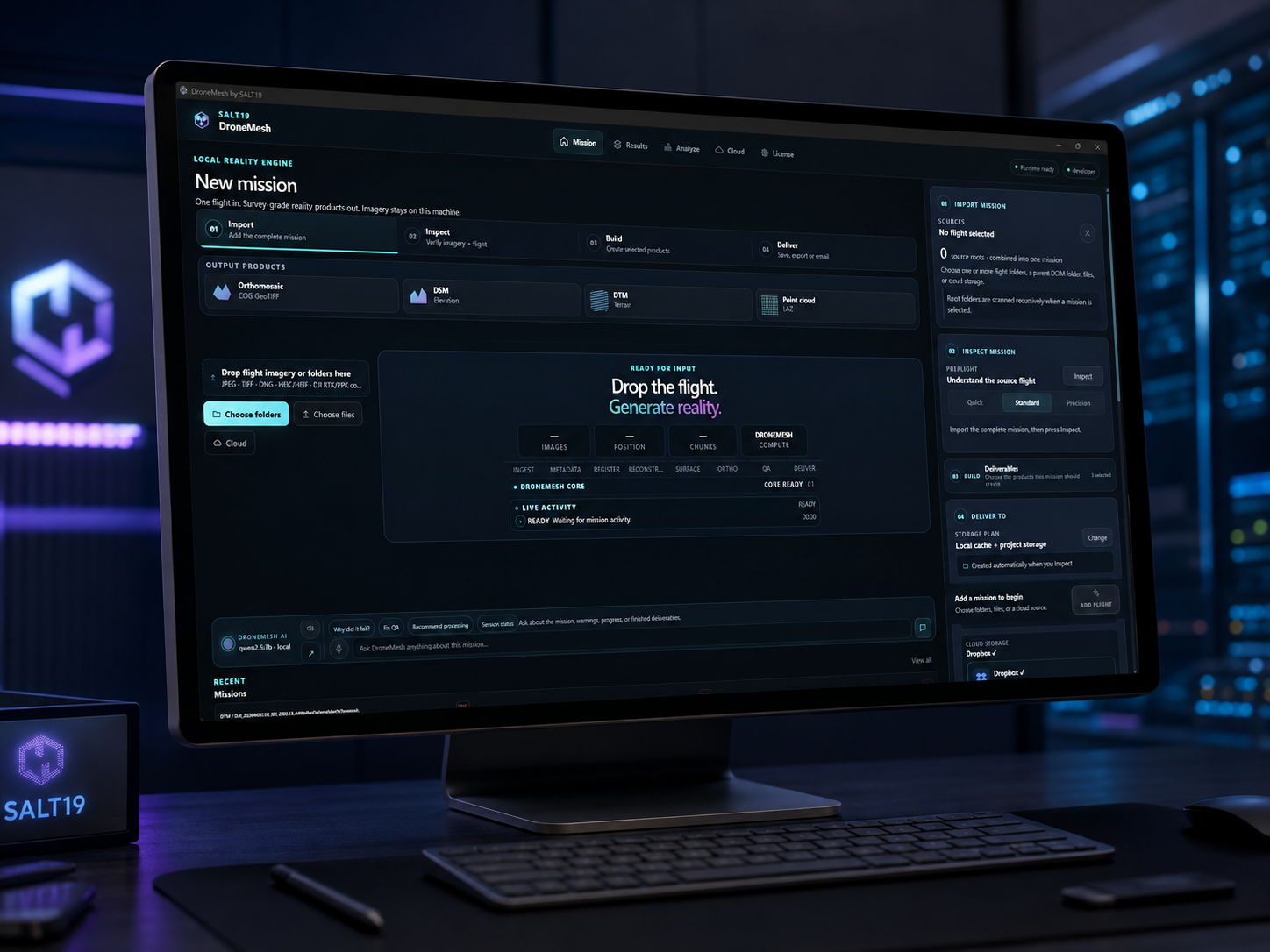
DroneMeshgeospatial production
TacWing-Xoperational autonomy
CloneCodelocal AI engineering
2020Founded
CurrentPaid catalog entries*
5DOI-backed EvoMind records
v0.5.0Official MCP Registry release
FAA SWIMIntegrated in AeroClear
Investment thesis

One architecture. Multiple commercial surfaces.

SALT19 is being built around a systems thesis: increasingly capable models are only one layer of useful autonomy. Real-world AI needs persistent state, authority boundaries, verification, operational context, reliable interfaces, and commercial rails. Those primitives can be reused across products instead of rebuilt from scratch for every application.

The portfolio is connected by shared engineering, not by branding.

EvoMind explores governed cognition. Agent Utility Grid turns bounded technical capabilities into machine-purchasable services. AeroClear, DroneMesh, and TacWing-X apply operational intelligence to UAS and geospatial work. CloneCode carries local-first, reviewable AI into software engineering. Different markets, but recurring infrastructure: reasoning, permissions, evidence, local control, tool execution, and verification.

01
Models are components, not authority.

Execution rights, verification, and state are architectural concerns rather than prompt conventions.

02
Operational software must close the loop.

The value is in turning data and intent into reviewable work products, not just producing model text.

03
Local-first can be a product advantage.

Where customer data, geospatial imagery, code, or operational context is sensitive, local processing reduces unnecessary data movement.

04
Proof compounds.

Public validation records, live endpoints, shipped software, and reproducible engineering evidence reduce the gap between a technical story and an investable company.

Momentum & company developments

The proof surface is expanding.

SALT19 applies a disciplined investor-relations hierarchy: current developments sit next to the evidence that supports them. At private-company stage, engineering milestones, shipping velocity, production infrastructure, and commercial validation matter more than public-market reporting furniture.

AeroClear adds FAA SWIM aviation-data integration.

The UAS flight-intelligence platform is expanding beyond weather and launch context toward a richer operational airspace picture.

Explore AeroClear →

DroneMesh moves toward a local photogrammetry production workflow.

Orthomosaics, elevation products, point clouds, meshes, contours, reporting, and local AI assistance are being assembled into a desktop-first production system.

Explore DroneMesh →

Agent Utility Grid expands machine-native commerce.

The production grid exposes machine-discoverable paid utilities, x402 payment gating, bounded decisions, fresh-state primitives, and verification-oriented receipts.

Open the grid →

EvoMind maintains a DOI-backed public research and validation record.

Architecture, verification, capability progress, and research boundaries are published instead of being collapsed into a single marketing claim.

Open research record →
Machine-native commerceCurrent live paid catalog entries*

The live Agent Utility Grid catalog is the authoritative discovery surface and now includes decision products, commerce verification, and fresh-state primitives. The count updates from production when the browser can reach the API.

Live catalog ↗
DistributionOfficial MCP Registry identity

io.github.GabrielAllit1/salt19-agent-utility-grid provides a machine-discoverable remote MCP distribution surface.

Registry & endpoint evidence →
Research discipline5 DOI-backed EvoMind records

Software, governed cognitive architecture, semantic transitions, experience compounding, and verified work-product research are independently addressable public records.

Research & publications →
Company cadencePublic engineering updates

SALT19 publishes what changed, what is live, what is still in validation, and what is coming next.

September development update →
Strategic portfolio

From research core to commercial wedges.

The portfolio is intentionally presented by maturity. "Live," "production," "active development," and "research" are not interchangeable labels. Investors should be able to see where commercial traction can occur now and where the option value is being built.

Research / platform core

EvoMind

Governed cognitive architecture

Persistent reasoning, memory, planning, capability composition, governed execution, verification, provenance, and controlled experience-driven improvement.

Commercial vectorLocal and enterprise autonomy runtime, governed agent infrastructure, and strategic pilots as maturity advances.
Research & validation →
Production

Agent Utility Grid

Machine-native technical services

MCP-discoverable utilities with x402 payment gating, fresh external-state primitives, structured outputs, bounded decision products, payment settlement checks, and verification-oriented evidence.

Current monetizationUsage-based machine purchases across the production catalog.
Commercial infrastructure →
Live product

AeroClear

UAS flight intelligence

Weather, GNSS and space-weather context, nearby cooperative traffic awareness, terrain, AOI planning, aircraft limits, launch-window analysis, FAA SWIM integration, and reports.

Commercial vectorSubscription and professional UAS operational intelligence.
Open AeroClear →
Active engineering

DroneMesh

Local geospatial production

Desktop-first photogrammetry and geospatial production designed to keep source imagery and processing local while producing operational deliverables.

Planned monetizationDesktop licensing, professional workflows, and local geospatial production capabilities.
Open DroneMesh →
Convergence validation green · hardware re-validation pending

TacWing-X

Vendor-neutral robotic edge C2 & governed autonomy

DJI MSDK V4 and MAVLink v2 share one governed runtime for perception, persistent world state, resilient localization, platform capability profiles, authenticated federation, action receipts and verification. PR #25 passed full DJI + MAVLink convergence validation in run 34770524183; fresh signed RM500/Air 2S evidence remains the release gate.

Commercial vectorOperator C2 software, platform integrations, ROS 2/robotic federation, field validation, and enterprise autonomy deployments as platform evidence matures.
Open current TacWing-X engineering checkpoint →
Active validation

CloneCode

Local AI software engineering

A local coding workspace centered on reviewable engineering, workspace authority levels, code intelligence, and AI assistance without turning the model into an unchecked controller.

Planned monetizationLocal software licensing and professional developer workflows.
Open CloneCode →
Shipping evidence beyond the six strategic systems: SALT19 also exposes public software surfaces including SignalLoom InvoiceOps, UAS Survey Tool, Patriot Claim Tracker, and Recruiter.ai. These demonstrate delivery across Windows, web, and browser-extension form factors.
See product updates →
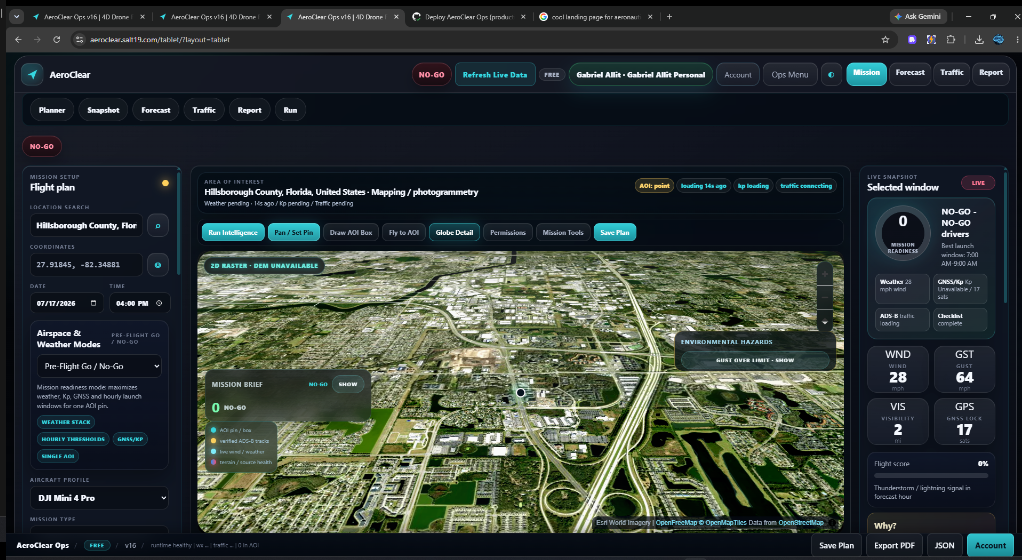
AeroClear UAS flight-intelligence dashboard
AeroClear · live operational product surface
DroneMesh local photogrammetry and geospatial production interface
DroneMesh · active engineering and validation surface
Business model

Several monetization rails. One technical foundation.

SALT19 is early-stage and does not publish audited financials or claim portfolio-wide commercial maturity. The model is to commercialize shared technical capability through the pricing form that best matches each buyer and workflow.

01 · SOFTWARE

Subscription products

Recurring access where value is continuous, such as operational intelligence and professional software.

Primary current wedge: AeroClear.
02 · MACHINE COMMERCE

Usage-based services

Per-operation technical utilities purchased by software agents rather than only by human end users.

Current infrastructure: Agent Utility Grid + x402.
03 · LOCAL SOFTWARE

Desktop licensing

Local-first tools for workflows where data gravity, privacy, latency, or operator control favor workstation execution.

Development vectors: DroneMesh and CloneCode.
04 · ENTERPRISE

Integration & deployment

Higher-value deployments where autonomy, governance, UAS operations, or local infrastructure must fit an existing system.

Future vectors: EvoMind and TacWing-X.
Why now / defensibility

Capability is accelerating. Control and operationalization are the bottlenecks.

Why the timing matters.

Models are becoming interchangeable faster than operational systems are. Durable value shifts toward orchestration, authority, state, interfaces, data workflows, and verification.
Agents increasingly need economic rails. Machine-discoverable services, payment challenges, settlement, idempotency, and durable receipts are infrastructure problems, not prompt-engineering problems.
UAS software remains fragmented across planning, airspace context, processing, and field operations. SALT19 is building connected wedges across that lifecycle rather than treating each as an isolated dashboard.
Local-first matters when the data is the asset. Code, imagery, operational telemetry, and enterprise context often should not leave the customer's environment simply to access AI assistance.

What can become defensible.

Implementation depth across the full loop. SALT19 is building cognition, execution, verification, payments, UAS context, geospatial production, and local interfaces rather than stopping at an LLM front end.
A common systems spine across products. Reusable governance, evidence, local execution, capability boundaries, and machine interfaces can make each subsequent product cheaper and faster to develop.
Domain knowledge at the AI/UAS/geospatial boundary. Operational workflows can create a stronger moat than model access alone because they encode how real work is planned, constrained, executed, and inspected.
Public evidence discipline. DOI-backed research, validation pages, production endpoints, release boundaries, and shipped software create a record competitors cannot reproduce with a landing page.
External discovery & research context

Outside systems are beginning to classify and test parts of the stack.

These are useful third-party signals, not substitutes for customer traction, independent replication, certification, or audited financial evidence.

MCP discovery · operational signal

Glama independently lists Agent Utility Grid as Healthy.

Glama currently marks ownership verified, reports the remote MCP service Healthy, and exposes 33 tools across autonomous-agent, orchestration, and security categories. Its recorded test date is September 3, 2026.

Open Glama listing ↗
Research indexing · taxonomy signal

The Grid is appearing in multi-agent security research discovery.

MultiAgentSecurity.ai maps the Agent Utility Grid paper into Trust & Identity, Governance & Policy, and Agent-to-Agent Communication. That classification helps place the architecture in an emerging research conversation.

Open research index ↗
Related-work convergence · context

Runtime governance, persistent memory, execution provenance, and verified state change are becoming recognizable research categories.

SALT19 treats that convergence as context for EvoMind and VST, not as proof of priority or novelty. The relevant question is where SALT19's implementations and claims remain specifically differentiated.

Open SALT19 research record →
Claim boundary: directory health checks, scholarly indexing, and neighboring research do not independently validate EvoMind, VST, Agent Utility Grid economics, or SALT19's commercial prospects. They are external discovery and context signals only.
Capital fit

The goal is not the most investor conversations. It is the right capital and the right network.

SALT19 is evaluating capital by what it can accelerate: enterprise access, field validation, technical recruiting, distribution, and disciplined concentration on the strongest commercial wedges. Conventional VC is one route, not the only useful route.

Venture capital

AI infrastructure, deep tech, autonomy, UAS, geospatial and developer infrastructure.

Best fit where investors understand technical de-risking, systems architecture, and long-cycle platform value rather than evaluating SALT19 as a collection of unrelated apps.

Strategic / corporate capital

Industry relationships can be as valuable as the check.

Strategic investors in aviation, robotics, infrastructure, industrial software, geospatial systems, or dual-use technology may accelerate integration access, pilots, and distribution.

Pilot & design partners

Operational evidence can precede institutional capital.

Qualified enterprise or government pilot sponsors can help convert software-alpha capability into measured field evidence, buyer understanding, and a clearer commercialization path.

Public financing boundary: SALT19 is not publishing a valuation, round size, allocation, securities terms, customer pipeline, or capitalization table here. Those belong in qualified direct diligence.
Capital acceleration

Capital should compress the path from technical proof to repeatable distribution — and bring useful access with it.

SALT19 is opening conversations with investors and strategic partners who understand applied AI infrastructure, autonomy, machine commerce, UAS, geospatial systems, and founder-led deep-tech execution.

What funding changes.

The company has already built a broad technical base. The next financing question is not whether more ideas can be generated; it is how quickly SALT19 can concentrate those assets into the strongest commercial wedges, validate demand, harden production systems, and add the people and infrastructure required for repeatable growth.

SALT19 does not publish a financing amount, valuation, round structure, or securities terms on this public page. Those details belong in direct investor conversations and formal financing materials.
CommercializationAeroClear + DroneMesh

Move from strong technical surfaces toward repeatable paid adoption, onboarding, support, and customer evidence.

Field validationTacWing-X

Complete PR #25 convergence, produce a fresh signed RM500 candidate, and repeat Air 2S/RM500 bench and controlled-flight evidence across video, telemetry, map/FPV interaction, perception, tracking, clearance truth and end-to-end operator control before release authority advances.

Machine commerceAgent Utility Grid

Grow qualified external usage, improve buyer conversion, deepen reliability, and expand machine-native distribution.

CognitionEvoMind

Advance independent benchmark evidence, enterprise-grade runtime boundaries, transfer, memory, planning, and governed execution.

TeamSelective hiring

Add product, engineering, field, commercial, and partnership capacity where it directly unlocks validated milestones.

Trust infrastructureSecurity + reliability

Strengthen testing, observability, deployment controls, documentation, compliance readiness, and operational resilience.

External buyer conversion

Increase independently qualified paid machine transactions and repeat use in Agent Utility Grid.

Paid product adoption

Turn AeroClear and DroneMesh product capability into customer and usage evidence.

Independent validation

Expand EvoMind evidence beyond internal engineering gates into externally legible benchmark and replication results.

Focused execution

Use portfolio learning to concentrate resources on products showing the strongest combination of pull, margin, and strategic leverage.

Gabriel Allit, founder of SALT19
Founder-led engineering

Gabriel Allit

Founder · AI systems engineer · autonomous systems developer

SALT19's founder is directly involved in architecture, implementation, validation, and product development across governed AI, autonomous systems, UAS workflows, geospatial processing, machine-native services, and local software. The public record includes an ORCID research identity, DOI-backed EvoMind publications, live products, and production infrastructure. For an early-stage technical company, founder-market fit is not a biography claim; it is visible in what has been built and documented.

Investor reality check

A credible venture case includes what still has to be proven.

SALT19's public materials intentionally distinguish implemented capability from external validation and technical breadth from commercial traction. These are the issues an investor should test, not hide.

What is still early.

Several systems remain in active development or validation. The company is founder-led and resource constrained. Not every product is revenue generating. Breadth creates execution risk. Those are normal early-stage conditions, but they need to be managed through focus, evidence, and milestone discipline.

Commercial concentration

Technical output has outpaced broad market adoption. Financing should increase customer discovery, distribution, onboarding, and conversion discipline.

Portfolio breadth

Multiple credible systems can dilute attention. Capital allocation should favor shared infrastructure and the commercial wedges with the strongest observed pull.

EvoMind claim boundary

EvoMind is AGI-oriented research and engineering. SALT19 does not present it as externally certified AGI or universal intelligence.

Validation boundary

Public validation is engineering evidence unless a result explicitly states independent replication or external certification.

Machine-commerce volatility

Early machine-paid demand can be sparse or uneven. The important proof is qualified external usage and repeat conversion, not synthetic traffic.

Regulated operations

UAS software supports planning and operational awareness. It does not replace pilot responsibility, regulatory compliance, or required aviation authority.

Public diligence room

Don't take the pitch on faith. Inspect the evidence.

Strong investor relations are built on the same fundamentals at any stage: current company developments, transparent evidence, governance boundaries, clear strategy, and a direct contact path. SALT19 applies that discipline at private-company scale by linking investors directly to first-party proof.

Private diligence: financing terms, capitalization, detailed financial model, customer or commercial pipeline information, and corporate/legal materials are not published on this public page. Appropriate materials can be discussed or shared directly during a qualified investor process, subject to confidentiality and availability.
Investor contact

Back the layer that makes intelligence accountable in the real world.

SALT19 is interested in investors and strategic partners who can help turn a deep technical base into focused distribution, external validation, commercial adoption, and durable company value.