Bring in live platform evidence.
Video, telemetry, navigation state and supported external observations enter through platform-aware adapters.
TacWing-X combines live video, local perception, resilient localization, persistent world state and platform adapters into one operator-centered edge system. It is designed to give different robots a common operational picture without giving external software unchecked actuator authority.
TacWing-X keeps sensing, interpretation, operator intent, policy and physical execution separate so the system can add intelligence without hiding where authority comes from.
Video, telemetry, navigation state and supported external observations enter through platform-aware adapters.
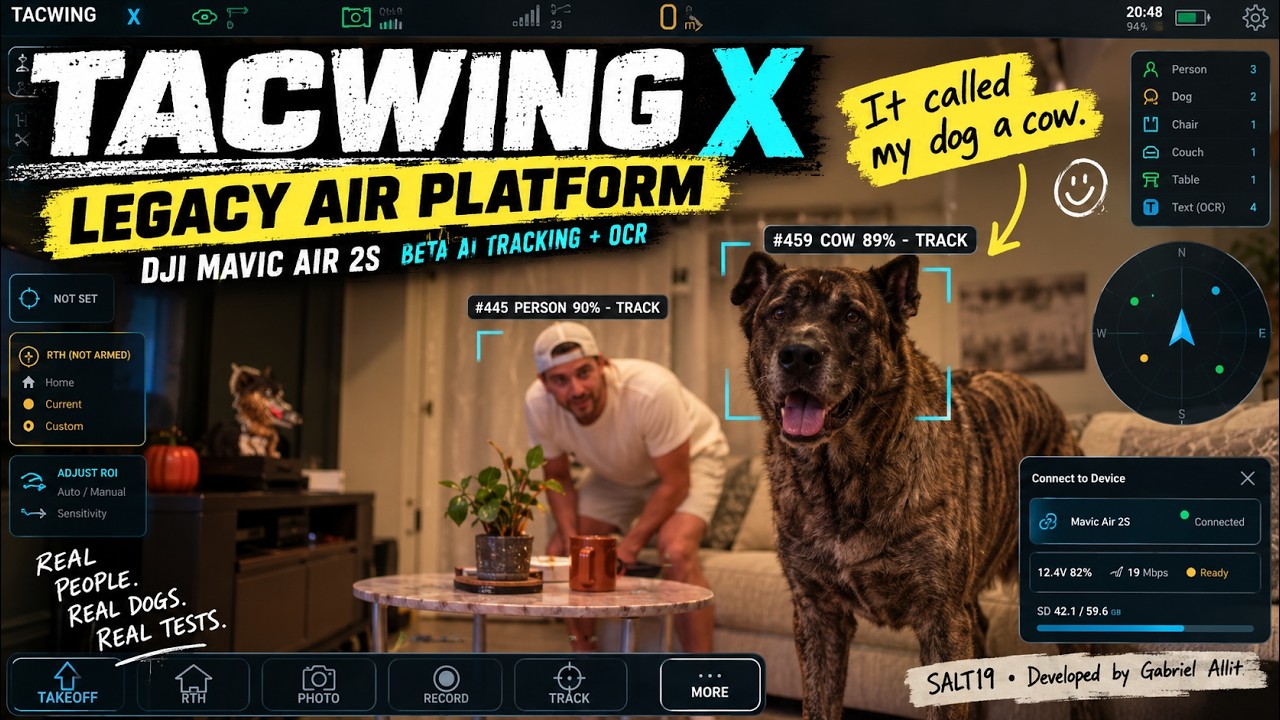
Offline perception, motion analysis, OCR and persistent visual tracks support operator awareness without requiring cloud inference.
GNSS, inertial state, visual odometry and dead-reckoning inputs are supervised with explicit integrity and degradation states.
Tracks and observations enter a provenance-aware world model with freshness, uncertainty and source context.
Perception and planning can inform a decision, but physical commands remain subject to policy, operator intent and platform limits.
Action receipts and postcondition evidence distinguish a requested operation from a confirmed physical outcome.
TacWing-X is structured around platform adapters instead of binding the operator experience to one aircraft or one robotics stack.
Controller-side video, telemetry, tracking and governed command integration through DJI Mobile SDK V4, with Air 2S + RM500 as the primary physical proving configuration.
See validation boundary →
A shared core supports MAVLink v2 telemetry, localization, command acknowledgement, camera/gimbal discovery and compatible video paths for PX4/ArduPilot-class systems.
Explore capabilities →
Authenticated federation lets companion computers and external sensors contribute bounded observations while local platform authority stays separated.
Open the ROS 2 architecture →TacWing-X can detect, track, fuse, predict and propose without turning every perception result into a movement command. That separation is central to the architecture.
Local detections and motion tracks support awareness and target selection.
Source quality, freshness and uncertainty stay attached to observations.
Commands remain bounded by platform capabilities, configured policy and native safety systems.
The system is designed so an object detector, OCR result, prediction model or external ROS node cannot silently inherit flight-control authority merely because it produced a confident output.
The Meta Quest companion is designed as a read-only awareness layer for authenticated platform state, localization integrity, tracks, geometry and mission context. It is not a second flight controller.
The current software stack has integrated DJI and MAVLink compositions, local perception, world-state handling, governance and federation. A fresh signed RM500 + Air 2S hardware cycle is still required before production-flight or broad hardware-support claims.

How air, surface, ground and companion systems can share authenticated observations without creating a remote actuator bypass.
Open ROS 2 pageHow platform state, localization integrity and shared world information can be presented as a read-only companion awareness surface.
Open Quest pageDiscuss hardware, operating environment, validation criteria and integration requirements for a bounded field evaluation.
Discuss a pilot